
At the Still Point and You Are Accepted
At the Still Point & You Are Accepted
Meditations for an Age of Forgetfulness – A Paired Poetry Collection.
Sixteen Disclosures and Shaking the Foundations
Poetry, Grace, and the American Soul
“We are not saved by ideas, but by grace.” — Paul Tillich
“All shall be well, and all manner of thing shall be well.” — Julian of Norwich
It often happens quietly.
A reader opens a book not expecting revelation, only rest. The mind is weary of argument; the heart, exhausted by the day’s noise. And yet, somewhere between word and silence, the world begins to breathe again.
That is how it feels to open At the Still Point and You Are Accepted — as if one were standing at the edge of something ancient and tender, the threshold between despair and faith. These are not simply collections of poems. They are gestures toward wholeness — meditations for an age that has forgotten what wholeness sounds like.
In an America adrift in shouting, cynicism, and a strange hunger of the spirit, these twin volumes offer a quiet counterpoint. They do not rage; they remember. They remind us that what saves us has never been certainty, but grace — not noise, but the stillness from which all true speech is born.
At the Still Point — Where Love Becomes Language
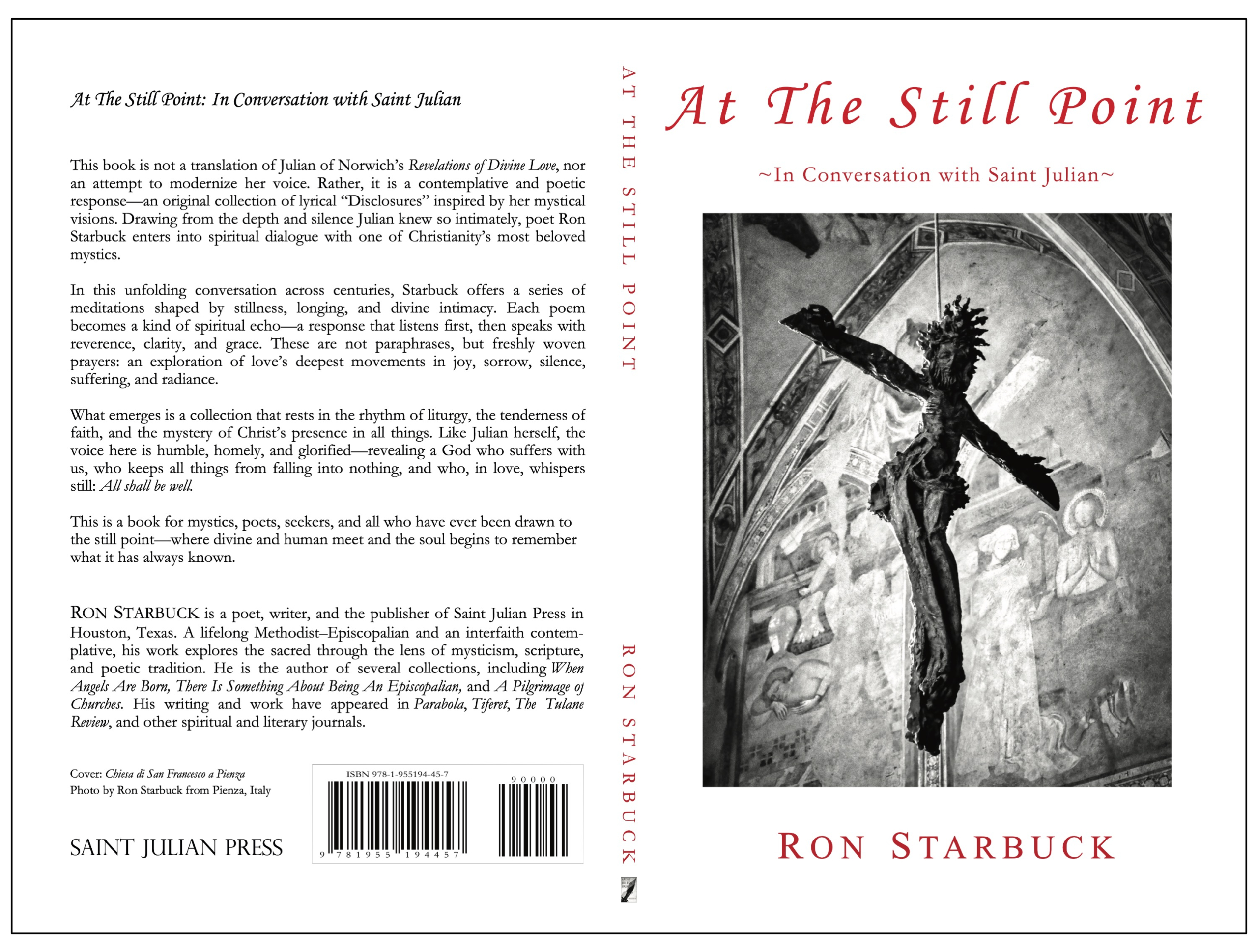 In At the Still Point, the medieval mystic Julian of Norwich becomes our guide through unknowing. Writing from a small cell during a plague and time of loss, Julian envisioned not a God of wrath, but a God who mothers creation with mercy. Her insight — that love holds even what is broken — stands as one of the most radical affirmations in Christian thought.
Ron Starbuck listens for that same heartbeat. His “Disclosures,” written as luminous meditations, do not explain Julian; they converse with her. The poems become a living chapel of words, where the sacred and the sorrowful meet. They remind us that contemplation is not retreat but engagement — the kind that heals perception and reawakens reverence.
In these verses, Christ’s tenderness and Julian’s courage converge. The poet’s voice carries both awe and ache, revealing a love that does not remove suffering but transforms it. Such love is the still point itself — the center that holds when the outer world comes undone.
At the Still Point: In Conversation with Saint Julian is available from:
Bookshop.org
Barnes & Noble
Amazon
You Are Accepted — The Courage of Grace
If Julian spoke from the cloister, Tillich spoke from the ruins. His sermons rose from a century marked by war and the collapse of meaning. “You are accepted,” he preached, “accepted by that which is greater than you.” It was not consolation but revolution — a re-definition of faith as courage amid ambiguity.
In You Are Accepted, Starbuck responds as a poet who has walked through modern uncertainty with open eyes. The poems are intimate, searching, and deeply incarnational. They translate Tillich’s theology of grace into the grammar of experience — a grace that meets us in the places we hide from ourselves.
Here, grace is not a doctrine; it is a lived encounter. It begins in exhaustion and ends in surrender. It is what lets us stand again when we no longer believe we can. The poet’s gift lies in his refusal to separate the sacred from the human. Tillich’s existential courage becomes the poet’s quiet prayer: Even now, you are held.
You Are Accepted: In Conversation with Paul Tillich is available from:
Bookshop.org
Barnes & Noble
Amazon
The Dialogue Between Time and Eternity
Together, these two books form more than a pairing; they form a conversation across centuries about what endures. Julian’s mysticism and Tillich’s existentialism meet in a distinctly American voice — one that carries both hope and responsibility.
In the poet’s hands, their ideas are not abstractions but incarnations. They breathe in the language of ordinary wonder. They stand against the reduction of faith to slogans and politics, reminding us that theology begins not in debate but in awe.
This is poetry as liturgy, a renewal of the American spiritual imagination — that fragile but essential space where conscience and compassion meet. At a time when the nation feels divided between its fears and ideals, this kind of imagination is not decorative; it is redemptive.
The Light That Remains
Julian and Tillich both knew what it was to live through endings. So do we. Yet from those endings, they called forth visions of renewal — of a God who holds creation not by power, but by love.
In these books, that same love takes on a new language. It becomes a mirror for the American soul: flawed, searching, resilient, capable of grace.
In an age of fracture, Starbuck’s poetry invites us to pause — to stand at the still point where divine and human meet, and to remember that even in the long night, light remains.
It is the light that endures through sorrow and disbelief, through division and loss — the quiet flame that cannot be extinguished because it burns from within the mystery of being itself.
That is where Julian’s assurance and Tillich’s courage meet: in the faith that what is broken can still be blessed, and that love, older than pain, will outlast it.
It is, after all, the light that remains.
Ron Starbuck is the Publisher/CEO and Executive Editor of Saint Julian Press, Inc., in Houston, Texas. He is the author of There Is Something About Being an Episcopalian, When Angels Are Born,Wheels Turning Inward, A Pilgrimage of Churches, At the Still Point: In Conversation with Saint Julian,and You Are Accepted: In Conversation with Paul Tillich, and . His writing reflects a lifelong search for the sacred within everyday life, drawing upon Christian mysticism, Anglican and Episcopal Church traditions, interfaith dialogue, and contemplative practice.
His family’s story dates back to the Quaker settlers of Nantucket Island in the mid-to-late 1600s. It extends through North Carolina, Indiana, and Kansas after the Civil War, before finding its home in Texas in the mid-20th century. This heritage of faith and perseverance quietly informs his calling as both poet and publisher. He lives with his wife, Joanne, and their four-legged companion, Ryder, in Houston’s historic Heights neighborhood.
His book reviews, poems, essays, and translations have appeared in Parabola Magazine; Tiferet: A Journal of Spiritual Literature; The Criterion; The Enchanting Verses Literary Review; ONE from MillerWords; Pirene’s Fountain; Levure Littéraire (France); La Piccioletta Barca; and The Tulane Review. His ongoing reflections may be found on Substack at ronstarbuck.substack.com.
A lifelong Methodist–Episcopalian, he remains deeply engaged in Buddhist-Christian and interfaith dialogue, continuing a family tradition of faith and spiritual inquiry that has quietly shaped generations. He and his wife attend and are actively involved at Trinity Episcopal Church in Midtown Houston, part of the Episcopal Diocese of Texas. At Trinity, they both serve as Lay Eucharistic Ministers; he as a Lector, and his wife as Co-Director of the Altar Guild and an adult acolyte team. And in the past, on the vestry and clergy search committees.
Saint Julian Press Links
At the Still Point: In Conversation with Saint Julian
You Are Accepted: In Conversation with Paul Tillich
Cover Images: Chiesa di San Francesco a Pienza
Photo by Ron Starbuck from Pienza, Italy
At the Still Point is available from:
Print ISBN-13: 978-1-955194-47-1
eBook ISBN-13: 978-1-955194-48-8
Library of Congress Control Number: 2025940201
You Are Accepted is available from:
Bookshop.org
Barnes & Noble
Amazon
Print ISBN-13: 978-1-955194-47-1
eBook ISBN-13: 978-1-955194-48-8
Library of Congress Control Number: 2025940201