
Western Massachusetts passes first act of atonement for the sin of slavery
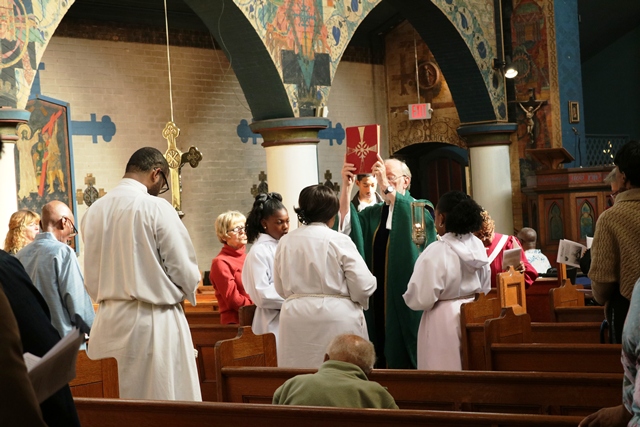
Gospel proclaimed by the Rev. Michael DeVine, Interim Rector, St. Peter’s Episcopal Church in Springfield, MA.
On Friday, November 14, the 124th Diocesan Convention of the Episcopal Diocese of Western Massachusetts passed the second resolution related to reparations. An act of atonement towards racial healing and reconciliation establishes an initial monetary commitment of $500 thousand dollars. Widespread movement to heal the financial impact of slavery is long overdue and can never make up for centuries of enslavement and racism. It is, however, incumbent on the followers of Jesus to own the truth of this sin and work to repair the real relationships among us that remain impacted by 400 years of White supremacy and racism.
The first atonement resolution in 2022 provided a space to acknowledge the sin of slavery and commit the diocese to truth-telling research and the work of repair. In 2023, the 123rd Diocesan Convention received an historical accounting of the origins of the endowment. The archival research established a solid line between the slave economy in New England and the foundation of the diocese in 1901. The resolution passed on November 14 represents three years of focused work on atonement and over a decade of becoming beloved community ministry.
This resolution will fund half-time leadership for our last historically Black congregation, St. Peter’s Episcopal Church, Springfield. The people of St. Peter’s were interviewed for a short-form video that was shown at the convention to give context for this ministry today. This priest will also be a half-time Missioner for Racial Reconciliation who will focus particular efforts among the youth of the City of Springfield and support our congregations in their work of repair and reconciliation. The search for this new position will begin in January 2026.
In his address to the 124th Diocesan Convention, Bishop Fisher traced the arc of this work in our diocese. “Here, we have held over 100 Sacred Ground Circles,” Fisher said. “How this has raised our consciousness of the sin of slavery, the dispossession of Native land. Becoming Beloved Community in this way required study, truth telling, discussion and prayer…It has transformed hearts and minds and has led us to learn our own true story as a diocese. We resolved to engage a historian to walk us through our archives and learn how our founding finances were directly linked to the slave economy in the North. Our decision to tell that important truth has led to the next step in our journey toward racial atonement, which you will be voting on later today.”
Presented by the Social Justice Commission, the resolution is the specific work of an atonement subgroup led by the Rev. Tim Crellin and the Rev. Dr. Harvey Hill. While this first act of repair is specific, the creation of the atonement fund will allow future contributions as the diocese and our congregations continue to make racial reconciliation a missional priority.
“We are working on God’s dream for us,” Fisher said. “Even though it seems far away, our love will make it real someday.”