
A restored portrait, a remembered legacy: Honoring Bishop Leopoldo Alard during Hispanic Heritage Month
“Things have a life of their own… it’s simply a matter of waking up their souls.”
— Gabriel García Márquez, One Hundred Years of Solitude
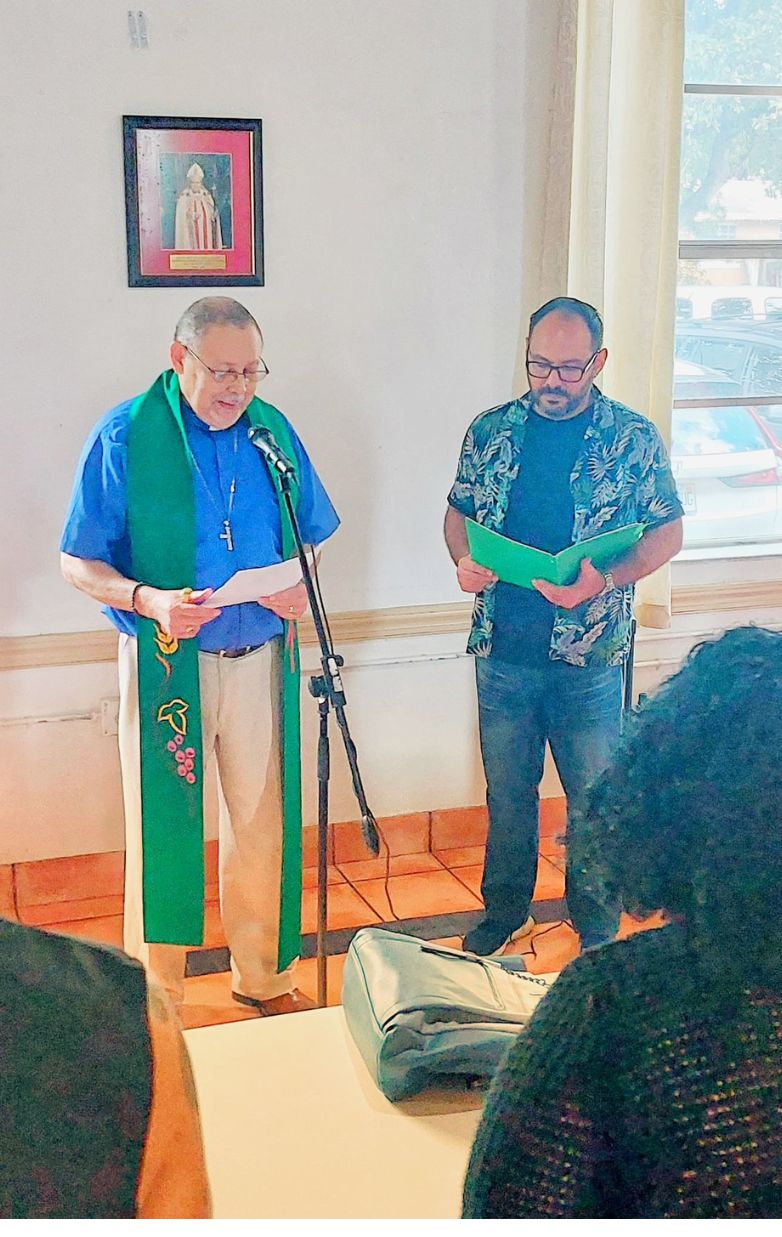
Fr. Dwight Morgan and Senior Warden Otero during the reinstatement ceremony.
In Gabriel García Márquez’s landmark novel One Hundred Years of Solitude, the town of Macondo is struck by a mysterious plague that steals sleep and, with it, memory. In a desperate act of resistance against collective amnesia, the townspeople begin to name the things that once defined them. Even the simplest objects must be labeled; as the novel puts it, “in order to mention them it was necessary to point.”
This fall, in a simple yet moving ceremony in Homestead, Florida, the community of St. John’s Episcopal Church took part in a similar act of remembrance. After years of being tucked away in a shadowy corner, the photograph of the Rt. Rev. Leopoldo Jesús Alard—the first Hispanic bishop elected in the Episcopal Church of the United States—was solemnly reinstated in the parish hall that bears his name. But this was more than the unveiling of an image: it was the recovery of a story, a waking of the soul.
A Legacy That Refuses to Fade
Born in Havana, Cuba, in 1941, Leopoldo Alard and his family fled the island in 1961 seeking refuge in the United States. He was ordained a priest in 1968 and served for more than a decade as rector of St. John’s, where his leadership helped shape the congregation’s bilingual and multicultural identity.
In 1970, Alard arrived at St. John’s initially as interim rector, appointed by Bishop James L. Duncan to serve a growing Spanish-speaking congregation. However, he was so beloved by the parish community that petitions were signed for him to remain as rector. Under his guidance, the church grew significantly, and, in 1973, a day school was established, which today serves over 150 students from Pre-K through 8th grade. In addition, the rectory was converted into offices for the church and school, solidifying St. John’s as a vital center of faith and education in the community. Those were years that, in Alard’s own words, were some of the most fulfilling and exciting of his life.
A pioneer for Hispanic clergy and a tireless advocate for the inclusion of women in ordained ministry, Rev. Alard was elected Suffragan Bishop of the Diocese of Texas in 1995. “I know that our Lord (…) is calling us to broaden the scope of the ministry that He has given us, that in these critical days more people will come to know the salvation of Christ Jesus,” he once expressed.
Until his passing in October of 2003, Rev. Alard was known for his deep commitment to building bridges across cultures, languages, and generations. Such a legacy, once at risk of being forgotten, now returns to a central place in parish life—literally.
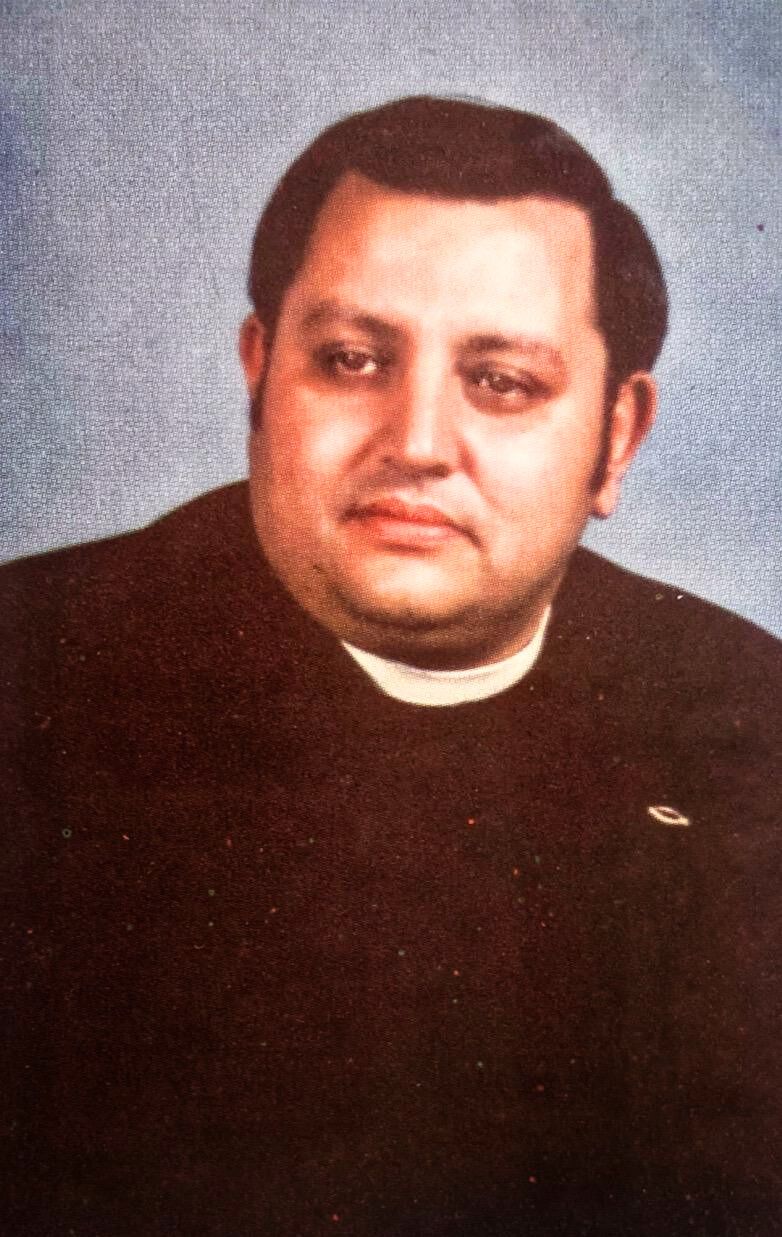
Bishop Leopoldo J. Alard
A Sacred Space, Reclaimed
The photograph now hangs in Alard Parish Hall, the very space where St. John’s gathers for coffee hour, fellowship events, and intergenerational celebrations. It is also where the schoolchildren eat lunch and where community groups like Alcoholics Anonymous and Boy Scout Pack 69 meet regularly.
The reinstatement ceremony, held during Hispanic Heritage Month, was officiated by Nicaraguan supply priest Father Dwight Morgan. Together with Puerto Rican deacon Vincent Tirado and dozens of Spanish-speaking parishioners, they sang, prayed, and reflected—reclaiming a legacy that had been silent for far too long.
The Fragility of Collective Memory
Why did it take so long? It’s a fair question—and one that goes beyond a single photograph. In churches, institutions, and societies alike, the voices of those who paved the way—migrants who sacrificed, clergy who spoke uncomfortable truths, and women who broke ecclesial ceilings—are too often forgotten, putting us at risk of repeating the exclusions they fought so hard to dismantle. Rather, evoking their vision—not as monuments, but as living reminders—can shape how we meet the challenges of today.
At a time when women in episcopal leadership—such as that of the Rt. Rev. Katharine Jefferts Schori, the first female Presiding Bishop of the Episcopal Church, and the newly elected Archbishop of Canterbury, Sarah Mullally—still face resistance, and when conversations around migration remain deeply polarized, Alard’s witness carries renewed urgency.
From now on, his holy gaze will watch over a space of laughter, struggle, prayer, and transformation—a space where the next generation of leaders will grow into the legacy of the one who helped lay the foundations of their still diverse and embracing church.
By remembering Bishop Alard, we remember who we are—and, most importantly, who we are called to be.
— Ahmed Otero serves as Senior Warden at St. John’s and was the one who envisioned the return of Bishop Alard’s photograph. He is currently discerning a call to ordained ministry in the Diocese of Southeast Florida.